A failed tile installation rarely begins at the grout joint. More often, the issue starts underneath: an tile adhesive o tile mortar selected without fully considering the tile, substrate, service conditions, and installation method. For distributors, contractors, and applicators, choosing the correct tile adhesive is a practical decision that directly affects productivity, durability, and call-back risk.
Why the right tile adhesive matters
Tile is only as reliable as the bond between its back and the substrate. Large-format porcelain, low-absorption ceramic, natural stone, and mosaics do not behave in the same way. The same is true of cement screeds, concrete, existing tile, gypsum-based surfaces, heated floors, balconies, and wet areas.
A standard cementitious adhesive can be appropriate for routine interior applications on stable, properly prepared substrates. However, it may not provide the deformability, open time, or adhesion needed for demanding conditions. Where movement, thermal stress, moisture exposure, or difficult tile backs are involved, product performance must be matched to the actual jobsite requirement rather than assumed.
This approach protects the installation and gives the contractor clearer control over application times, material consumption, and finished quality.
Selecting tile adhesive o tile mortar by application
The first question is not simply which adhesive is available. It is where and how the tile will perform once the job is complete.
Tile type and format
Porcelain stoneware has very low water absorption, so it requires an adhesive formulated to achieve secure bonding to dense tile backs. As tile dimensions increase, the importance of proper contact coverage also increases. Large-format tiles can amplify even small irregularities in the substrate, creating voids that weaken the installation and can lead to cracking or detachment under load.
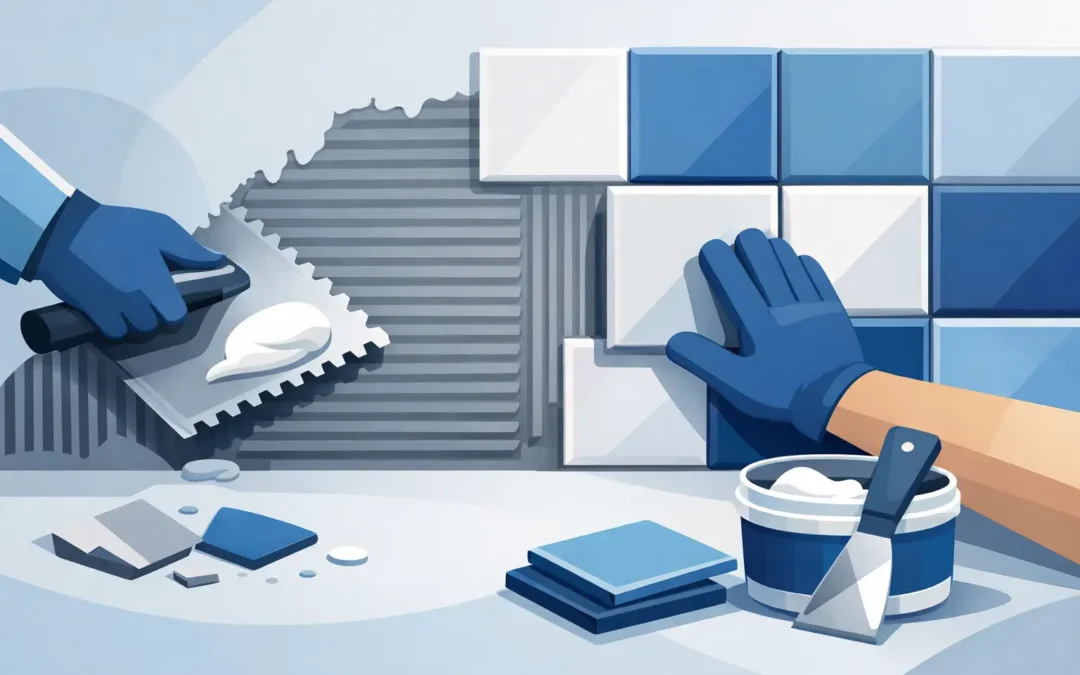
For large formats, a deformable adhesive and a suitable trowel notch are often necessary. Back-buttering may also be required to achieve continuous adhesive coverage. The goal is not merely to make the tile stick, but to minimize empty areas beneath it.
Natural stone requires additional evaluation. Some stones are sensitive to moisture or staining, while translucent materials can reveal color variations in the adhesive bed. In these cases, adhesive color, water retention, and the manufacturer’s stated compatibility should guide the choice.
Substrate condition
No adhesive compensates indefinitely for a weak, dusty, damp, or unstable substrate. Before laying tile, verify flatness, cohesion, curing, moisture condition, and the presence of residues such as paint, oil, curing compounds, or loose old adhesive.
Absorbent or powdery surfaces may require a primer to regulate absorption and improve adhesion. Uneven substrates should be repaired or leveled with a compatible product before tiling. Trying to correct excessive thickness with tile adhesive can compromise curing and dimensional stability, especially when the product is used outside its declared thickness range.
Existing tile can sometimes be tiled over, provided it is sound, firmly bonded, clean, and correctly prepared. This can reduce demolition time, but it is not the right solution when the existing layer has cracks, hollow areas, or moisture-related failures.
Indoor, outdoor, and wet applications
Bathrooms, showers, balconies, terraces, facades, and heated floors impose different stresses. Water exposure requires a complete system: substrate preparation, waterproofing where required, compatible adhesive, grout, and correctly executed joints. An adhesive alone cannot solve deficiencies in drainage, waterproofing, or movement-joint design.
Outdoor installations need particular attention to temperature changes, rain, frost, and solar exposure. A deformable adhesive helps accommodate movement between tile and substrate, but correct joint placement and full bedding remain essential. On balconies and terraces, voids beneath the tile can allow water accumulation and increase the risk of damage during freeze-thaw cycles.
Reading adhesive classifications with purpose
European cementitious tile adhesives are commonly classified under EN 12004. While the technical data sheet remains the reference document, the main designations help professionals compare performance.
A C1 adhesive meets basic requirements for a cementitious adhesive. C2 indicates enhanced adhesion, often appropriate where stronger bonding performance is needed. The letter T identifies reduced slip, useful for vertical applications, while E denotes extended open time. S1 and S2 refer to deformability, an important characteristic where the assembly is subject to movement or thermal variation.
These codes are useful, but they do not replace jobsite evaluation. A C2TE S1 adhesive may be suitable for many demanding applications, yet the correct selection still depends on substrate type, tile format, exposure conditions, and the rest of the installation system.
Application quality determines the final result
Even a high-performance adhesive can underperform when mixed or applied incorrectly. Water dosage must follow the technical data sheet. Adding extra water to make the mix easier to spread can reduce mechanical performance and increase shrinkage. Mixing time, resting time, and remixing also matter because they activate the additives designed to control workability and adhesion.
The adhesive should be combed in straight, consistent ridges rather than applied in random circular patterns. Place tiles while the adhesive is still fresh and within its open time. If a skin has formed on the surface, do not simply wet it and continue: remove and apply fresh material.
Periodic checks by lifting a newly placed tile are a simple, valuable control. They show whether the chosen trowel, adhesive consistency, and installation method are delivering the intended coverage. This small check can prevent a costly hidden defect.
For contractors and building-material distributors, dependable results come from treating tile adhesive as part of a complete technical cycle, not as an interchangeable commodity. Magix supports professionals with cementitious solutions and practical guidance that help align product performance with real jobsite conditions.
The best adhesive choice is the one that remains invisible after installation: holding the tile securely, accommodating the conditions it faces, and allowing the finished surface to perform exactly as designed.